Category: Audio Fundamentals

  • Evaluation: Sense of place

    During my process of creating your composition I used a range of non vocal sounds to utilise both percussive and ambient interest. Using a digicam recorder for a more analogue quality, I based my composition off of social spaces applying the brief of sense of place.
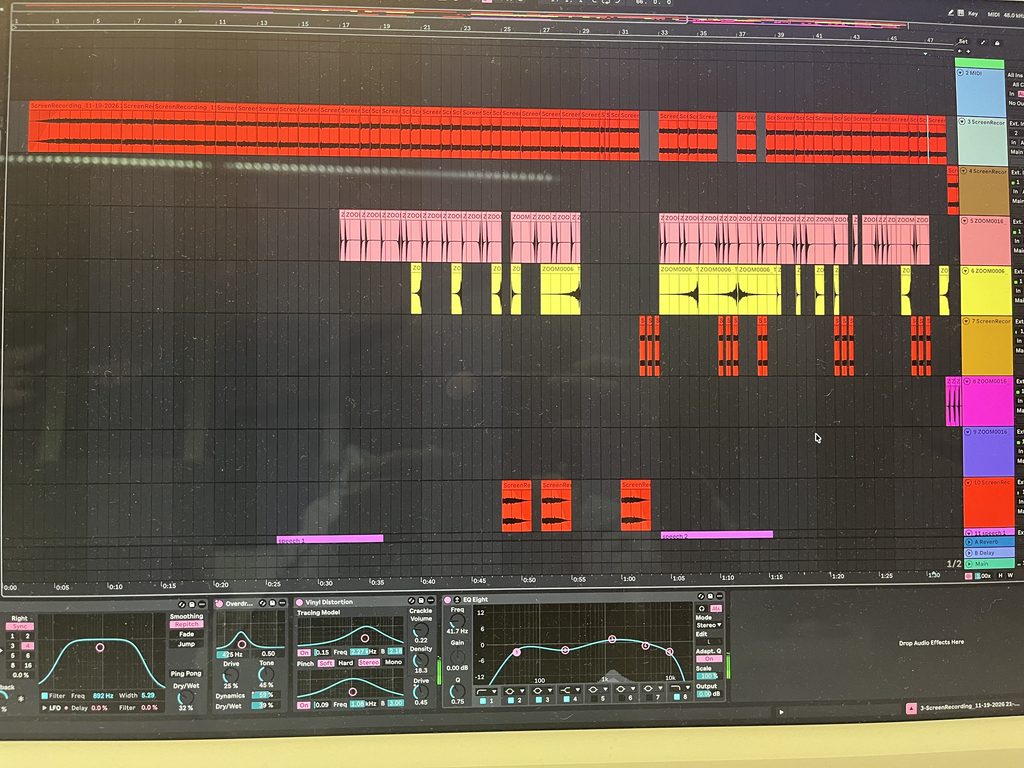
    During the first quarter of my composition I establish the atmosphere of being with friends in a vinyl bar (Cafe 1001 in Shoreditch). This is a regular Wednesday evening hangout for me and a few people in my accommodation where we go and enjoy the environment and the music as a bring your own vinyl night. This drew my attention to use in my composition as it holds sentimental value of having a select few people who simultaneously enjoy being in certain environments on a shared subconscious basis where there’s zero pressure on filling the silence as the air is filled with the noise of other people and the bustling atmosphere.

    I then decided to use a range of looping techniques for this track to be played continuously throughout and I automated a stereo delay effect as the night goes on and the conversation dies down again as on the way home, there is accurately sometimes this feeling of disorientation that goes unsaid.

    For my spoken word on the other hand, I took a more openminded creative approach using the mini descriptions on the back of monster energy cans, solely because I decided to take the idea of comfort and how certain things whether small or big can amass to unexpected periods of time with connotation of comfort. I kept the spoken word predominately clearer to continue establishing a narrative within my piece as I felt compositionally this felt most fitting and I applied little thought past that.
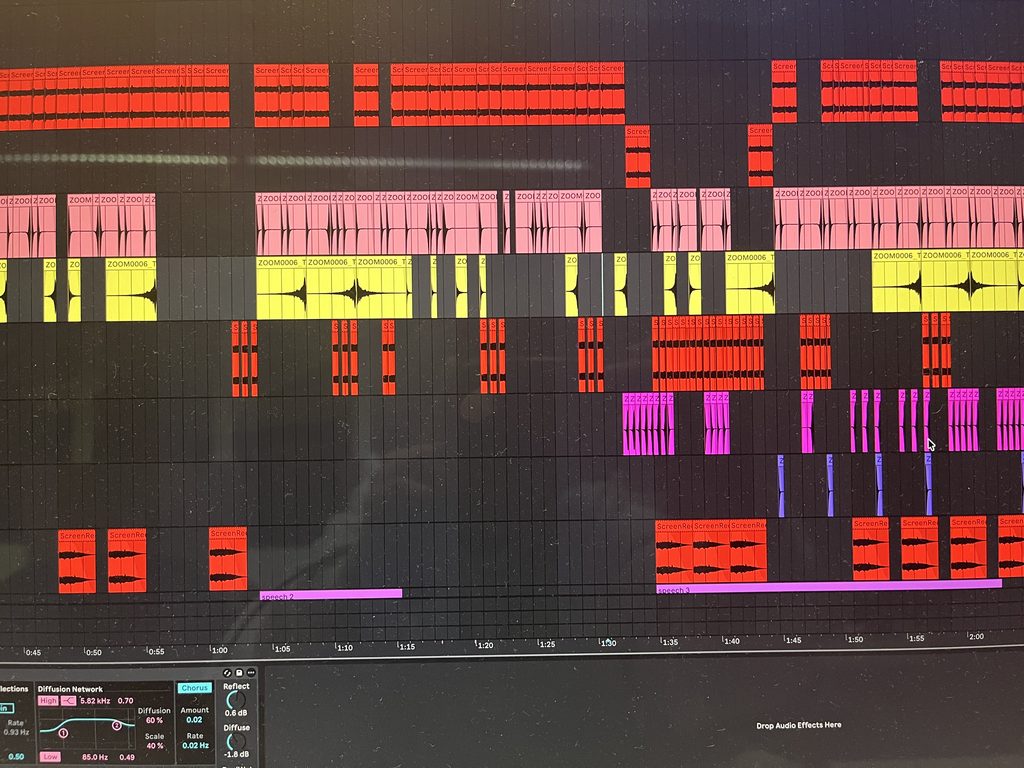
    The percussive sounds arose from lots of EQ to help keep a substantial pacing and I made these sounds purely from tapping or hitting different materials and using pitch shifting and time stretching techniques to ensure a baseline of instrumentation within the piece.I then, to create melodic effects, chopped up and used repeats and reverses to add a layer of depth towards the piece, using the original recording of being in the social environment, and felt a fascination towards how the resonant frequencies of overlapped voices sounded as a whole whilst treating the music in the back as a sample itself.

    I then treated the mix as a whole in conventional ways using EQ, saturation on lower frequency audios, compression and adjusting the gain and keeping the mix distortion and clipping free. Arguably for improvement I could maybe automate more of a street effect and utilise more experimental features along with ensuring the mix stays clean wth each instrument in a space.
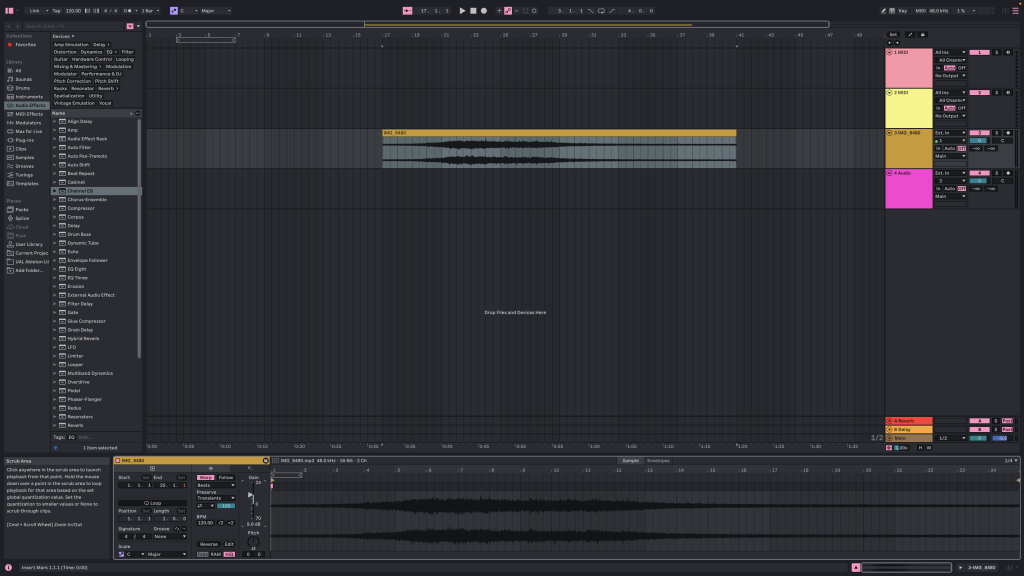
  • Loudness quietness and inbetween #5

    All recordings are taken from the first extract of the Kruetza Sonata by Tolstoy.

    In my recordings I chose a quiet place being my room whilst using my phone microphone being the standard settings of 44.1khz, the Nyquist standard whilst being 16bit. This is the same sample rate and bit depth as CDS whilst holding lossy quality. However due to the quality being arguably low for a microphone speaker this allows for upsampling and availability to future proof recordings using a DAW.

    For the moderately loud area, I chose a local park in where you could hear people walking past as well as general traffic and noises sound elephant and castle however this was a quiet estate for living in London. I then decided to alter my settings using Davincii resolve, a film app I use often when making films where you can adjust the audio settings as well as visuals. It offers conversion to lossless audio so I did so and converted the file into 48khz. Not much sounded different however lossy to lossless always offers extra benefits and when listening to more direct music, offers a clearly sound with more clarity to the mix.

    Finally I decided for a louder area, to enter a train station entrance as there was direct dialogue in the background. Not only this but this range of ambient noise as well as dialogue helped widen the frequency spectra of the recoding itself. With the beeping of the train gates long with the passing underground, as well as the outside world, this offered a place n where the noise floor of the recording itself would already be quite high. I began running out of storage however this wasn’t a problem overall but my clip was cut sort. However due the loudness of my surroundings I had become hyperaware of y own dialogue as people were next to me as well as theirs making it hard t read. However I then decided to use a higher sample rate, past 48khz. Being 96khz although unable to hear unless needing to use a large amount of manipulation, the process itself ensures future proofing if needed.

    I notice as a reoccurring theme that voices and the general public could be a way of establishing a baseline for composition reasons for the sound study, as through also reading the prior extracts that reference everyday life I am becoming hyperaware more of what our ears filter out with the differences in noise and separation of what classifies as “noise” and what has true sonic potential.

  • Microphones #3

    Torgue, H., (2005) Sonic Experience: A guide to everyday sounds

    Schafer, M. (1994) The Soundscape: Our Sonic Environment and The Tuning of the World

    Toop, D. (1995). Ocean of sound: aether talk, ambient sound and imaginary worlds.

    As i read Torgues, in the silence of my room, i noticed the topic of the extract i chose was particularly focused on acoustics in where he explains that for a sound to be masked it must be masked by a lower level frequency sound. During my recording i noticed that due to the lack of sounds around me past cars below me or the trains that constantly pass by, my voice began to have less clarity when reading. However this brought my attention to being hyperaware of everyday sounds around me, in which the extract had almost intentionally made happen. It talks of tonality and that regardless of tone being either complex or pure, through language also, sounds can be masked by most environmental factors within ordinary life. Linking directly to a sense of place as arguably sound keeps people grounded within an environment regardless of if their own voice is masked due to how the environment itself has its own noises with different frequencies.

    I then read Schafers soundscape in where, I decided to pick a moderately loud place being a supermarket, this atmosphere in itself holds a dense range of noise and sound in itself, In the extract Schafer talks about the Paris expositions, being a range of expositions celebrating and drawing list upon different decorative arts, music etc. As I walked around I began feeling more self conscious, particularly from the fact that I had no headphones on a I was mainly just speaking at my phone. However I noticed quickly the difference in voices around me along with the idea of atmospheres and how that can amplify in this case, the customer experience. Entirely through commercial sounding music and the idea of nostalgia from the thin sounding speakers that supermarkets have, along with the people themselves also shopping, it creates an experience ambience that otherwise not be there.

    In Toops Ocean of sound in a loud place, being near a fountain outside with the hustle and bustle of the city, including drilling and road noise. where i began reading the extract of Sun Ras dream. In Sun Ras dream, he explains that he has found jewellery that defies the expectation of “description” and goes on to explain that this jewellery doesn’t hold itself to the bounds of the universe, in which there are also no walls. This drew me back to the idea of atmospheres and ambiences within everyday life as it felt as if sound has no barrier and no limitations, in a volume sense on this earth humans can then only process what our brains are capable of. This created the idea that identity is limited to what the physical body can comprehend or is capable of and from a sound perspective, our place and identity is only so much as human which we become hyperaware of during louder settings.

  • Personal statement #2

    In my passion of sound design and sound as a whole I create a fluid working ability to adapt to any role within sound and music as a whole, through my background in tutoring and sharing my knowledge to younger generations i possess the understanding of not only teaching applications but understand the importance of being able to adapt the visual world to fit with the sound world and allow them to work together rather than separately. This brings me to my end goal being to be able to design music for film or fashion, whether it be advert or trailers, my work possesses a key theme of taking the pre-existing visual world and enhancing with the sound world itself through instrumental music, dependant not only on guitars but i gradually hold a high interest in electronic music due to its ability to hold and evolve sounds to fit in the mould of interest. Put simply the creation of material and the physical through a sound model where it is felt on an aural level the true dimensions of an object. I am keen to practice and learn more of how i can make my passion a place of perfection learning from basics to beyond an intermediate level and am aware of challenges of this being particularly learning new and different DAWs however this all in all means i have more knowledge and more freedom to express my work in ways i couldnt have before. This could also allow me to draw on new ideas for my work and bring all elements of my pre-existing knowledge together in ways i cannot yet foresee yet this creates an avenue of curiosity to grow within my work, being a chain reaction toward bigger and even more places of interest.(#2)

  • Location sound and recording #6

    I hired out a Rode NTG 5 condenser field mic recorder from the kit room and used the boom attachment along with the others on the end and experimented with adjusting gain levels along with how compression changes the atmosphere itself. Initially due to the microphone being a condenser my assumptions were that it would be sensitive due to its wide frequency response being the full spectre of human hearing in which i was correct.

    Firstly i attempted to record my room and see how sensitive the microphone was to what human ears would call silence, the microphone picked up a continuous hum possibly from the lights above me and any shifting noises that i made during recording i noticed this as it was connected to a small device which showed the waveforms themselves in real time. I also using headphones then opened my window in which i am next to the overground and a lot of noise tends to come through when it is coming.

    When i pushed the gain up, this accentuated the noise floor lots as it already is an extremely sensitive microphone and created artefacts and distortion but not in a desirable way and had a more white noise effect.

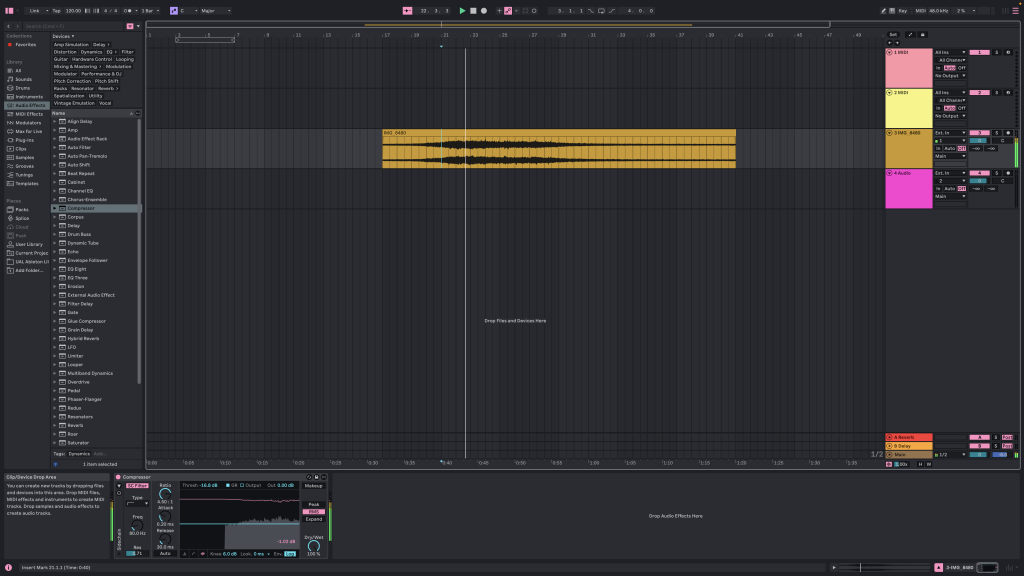
    When i then used a compressor, the dynamic range narrowed even further as it increased most of the room noise as the train itself passed by creating more distortion unless heavily compressed. Drawing my attention here towards how compression can be demonised within mixes for when things are too processed, yet narrowing the dynamic range when applied to a more ambient context can be something of use in my composition.

    Then i decided to use a limiter so only the peaks would be cut once it had hit over the different decibel settings i applied, typically above -10dbs. However using a limiter in this way to this extreme extent introduced clipping therefore automating or manually adjusting the gain helped when the train passed by instead of using a compressor or plugin. Not much changed in terms of clarity of recording when i changed each attachment therefore the dynamic range was extremely wide only when the train passed as it accurately picked up every sound that was made whether in a quiet or louder environment raising the noise floor.

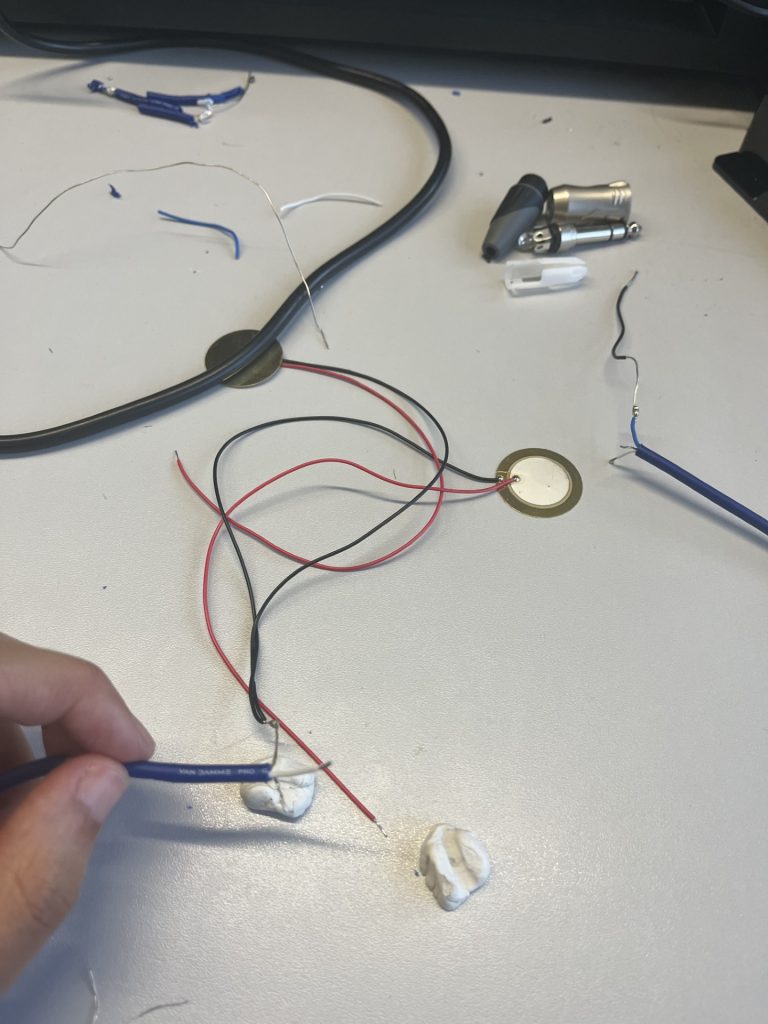
  • Contact Mic making. #4

    Next once all the soldering was finished, we hydro-dipped the contacts piezoelectric part of the microphone to create a rubber glaze, insuring that the microphone could still withhold its connectivity whilst simultaneously allowing the microphone to be both water resistant as well as being waterproof.

    After the press was done and I took the microphone home, tested out the microphone using my electric guitar, Vox speaker, in which I swiftly discovered by turning up the gain rather than volume, it created distorted effect based more of narrowing the dynamic range for the signal to come though.

  • Elevator pitch #1

    My current background in sound relies heavily on my passion for guitar, by learning guitar for a decade now overtime ive grown more tech focused and have an interest in the equipment itself not only the ability to play, but what appeals to an audience and how it can be enhanced through having better technology or the stylistic choices in using vintage hardware and saturation thus of the sound. I believe with my aspiration this makes the knowledge i have a great value towards my practice as i can use adaptable skills where possible in my research and work itself. Throughout learning more of these technical skills in college through my A level, I’ve reached a point where the theory behind the fundamentals is no longer new to me and I can easily understand and apply certain technical theory to a practical setting. I can easily set up a studio and work within a studio setting without needing much direction of navigating predominantly from my academic experience whilst keeping a separation between my guitar practices.

    Something I want to explore more is creating my own music and sound studies as I feel although I’ve gathered knowledge for this I’m keen to learn more of the practical basis for applying my own stylistic genre of sound and eventually be able to mix and master fluidly in a way that is professional. Not only this but I have built a small portfolio of my own work towards visual and sound practices together due to my widening interest in film making as well as sound so I can master them together purely out of passion. However something I haven’t yet explored is combining my two practices together which I am aiming to explore in the not so distant future as well as adopting new information particularly in terms of psychoacoustics and acoustic engineering in general as I feel there is a lack of web rounded understanding of all these contexts that are arguably what I would call my own practice.(#1)